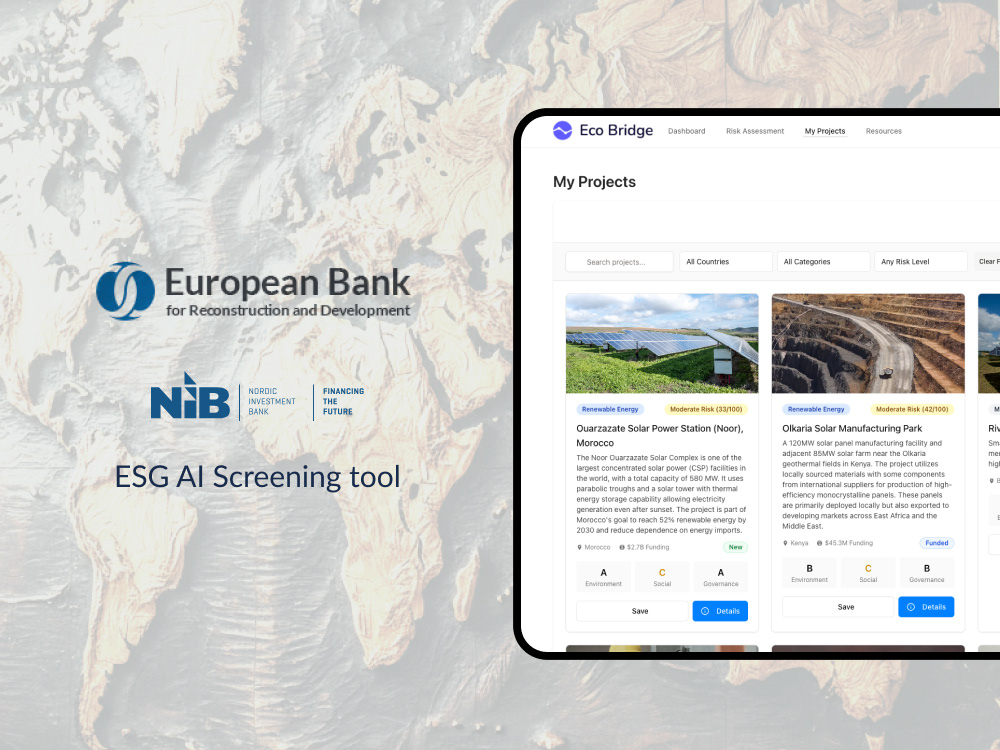
Designing an enterprise platform that helped specialists assess, monitor and make decisions on environmental and social risk more efficiently.
Client: EBRD - European Bank for Reconstruction and Development
Sector: Financial Services
My role: Product Designer, UX/UI Designer
Team: Product · Engineering · Data · Domain specialists
Project time: 6 months
My contribution: Research · Product strategy · UX · UI · Prototyping · Design system
The challenge:
Environmental assessments relied on fragmented information distributed across multiple systems, while interpretation depended heavily on specialist knowledge.
The outcome:
We transformed that fragmented process into a structured digital workflow supporting assessment, monitoring and traceability.
Why the existing process wasn't working
Fragmented information
Data required for an assessment existed across multiple sources.
Expert-heavy processes
Important decisions relied heavily on specialist knowledge.
Low process visibility
Teams struggled to understand status, ownership and next actions.
Business problems
User problems
High operational cost
Slow project assessment
Inconsistent risk evaluation
Difficult portfolio monitoring
Repetitive manual work
Hard to understand next actions
Information scattered across systems
Limited visibility into assessment state
What I was responsible for
Translate complexity into a usable workflow
Turn specialist-heavy processes into understandable steps without removing necessary domain information.
Create consistent interaction patterns
Design reusable patterns for assessment, monitoring, validation and feedback.
Align product and technical constraints
Work with stakeholders and engineering to ensure the experience could be implemented within the existing architecture.
Understanding how specialists actually worked
I mapped the end-to-end assessment journey with users and stakeholders to understand where information originated, who owned each decision and where work moved outside the platform.

The key finding
Users were not struggling primarily with individual forms. They were struggling to understand the relationship between information, ownership and the wider assessment process.
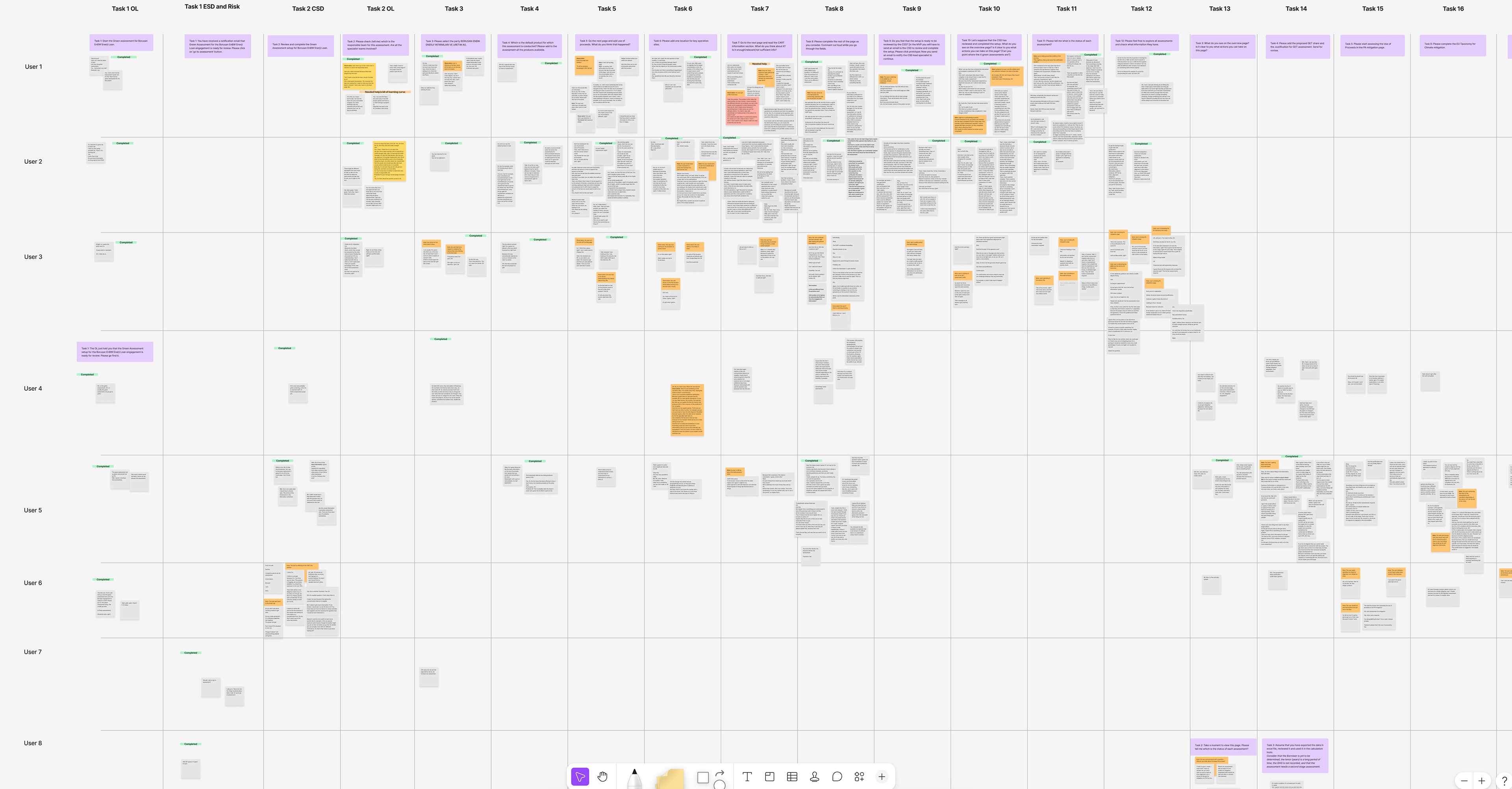
Interviews revealed three recurring problems
01. Users reconstructed context manually
They repeatedly moved between tools to understand the full project history.
02. Assessment status was unclear
Users knew what they personally had done but not always what remained.
03. Expert knowledge compensated for poor system guidance
Experienced specialists knew what to look for; less experienced users depended on colleagues.
Turning insights into design principles
Make status explicit
Users should always understand where an assessment is in the process.
Keep domain complexity, reduce interaction complexity
Specialist information remained available, but was grouped and sequenced around user decisions.
Bring guidance into the workflow
Users should not need separate documentation to understand what happens next.
Design for traceability
Actions and decisions needed to be understandable later by other specialists.
From fragmented assessment to one connected workflow
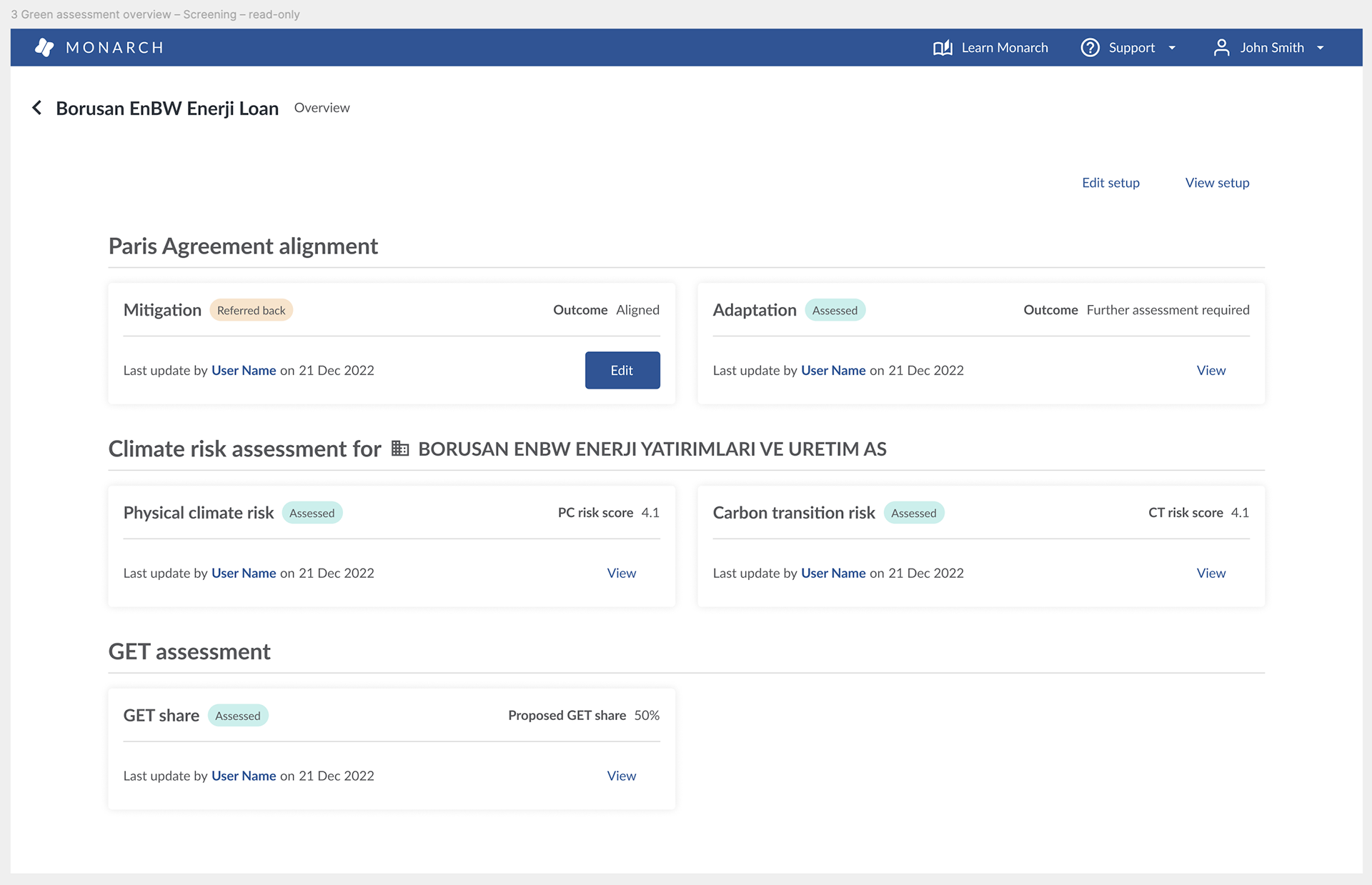
01. Establishing assessment context
I designed the assessment overview to provide specialists with the project context, assessment status and outstanding actions before they entered detailed review.
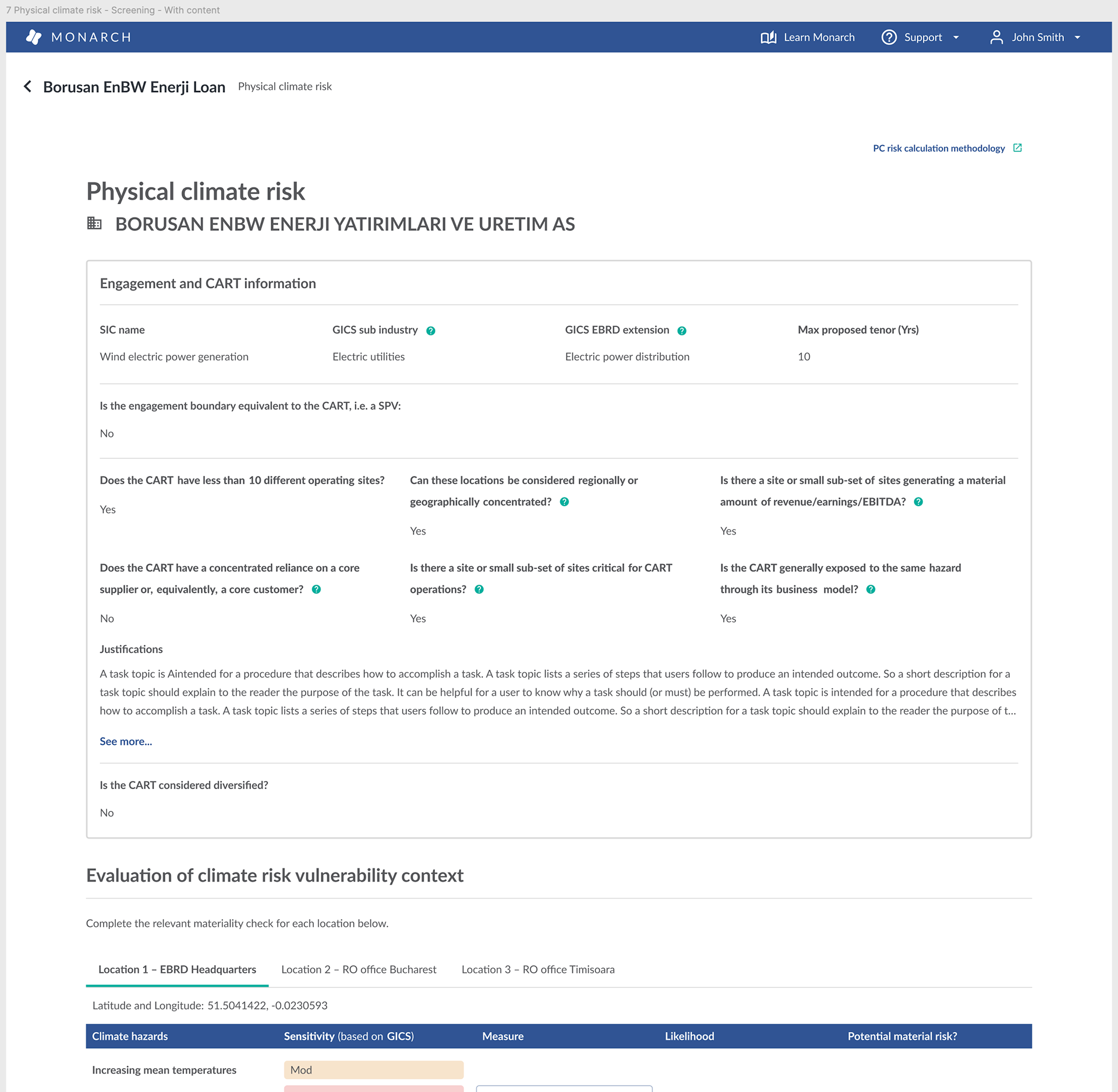
2. Structuring complex specialist information
Environmental data was progressively grouped around the decisions specialists needed to make, reducing scanning effort while preserving access to detailed evidence.
03. Making ownership and next actions visible
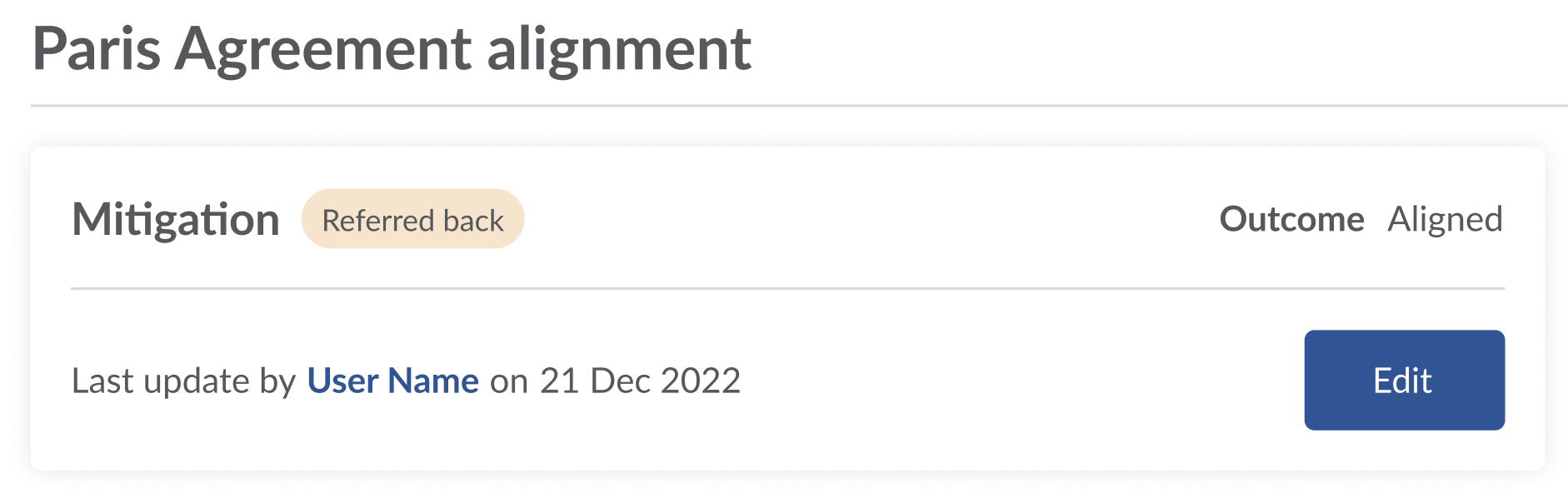
Clear ownership, progress states and contextual actions helped users understand what had already happened and what needed attention next.
Before
After
Fragmented information, offline collaboration
Manual coordination
Expert-driven interpretation
Poor status visibility
Manual coordination
Expert-driven interpretation
Poor status visibility
Centralized assessment context
Structured workflow
Reusable assessment patterns
Visible ownership and status
Structured workflow
Reusable assessment patterns
Visible ownership and status
Impact
For users
A more structured assessment workflow reduced the need to reconstruct information across disconnected sources.
For the product
Reusable patterns established consistent ways of communicating assessment status, actions and feedback.
For the organization
The platform helped digitalize previously fragmented environmental and social risk-assessment processes.
What I learned
This project reinforced that expert systems should not necessarily remove complexity. Environmental risk assessment is inherently complex; the design challenge was to structure that complexity so specialists could make decisions without reconstructing the process themselves.
What I would improve
I would introduce product analytics earlier to measure where specialists spend time, where assessments stall and which guidance is most frequently used.